The James Dyson Award 2025 announces its two Global Winners
Published: 5 November 2025
The James Dyson Award 2025 Global Winners in brief:
- Two world-changing inventions win the 2025 James Dyson Award, each receiving £30,000 to bring their ideas closer to commercialisation.
- The Sustainability Winner is WaterSense, an AI-powered device for real-time water quality monitoring device in rivers and lakes.
- The Medical Winner is OnCue, a smart keyboard for people with Parkinson's, using haptic and visual cues to manage motor symptoms and reduce typing errors.
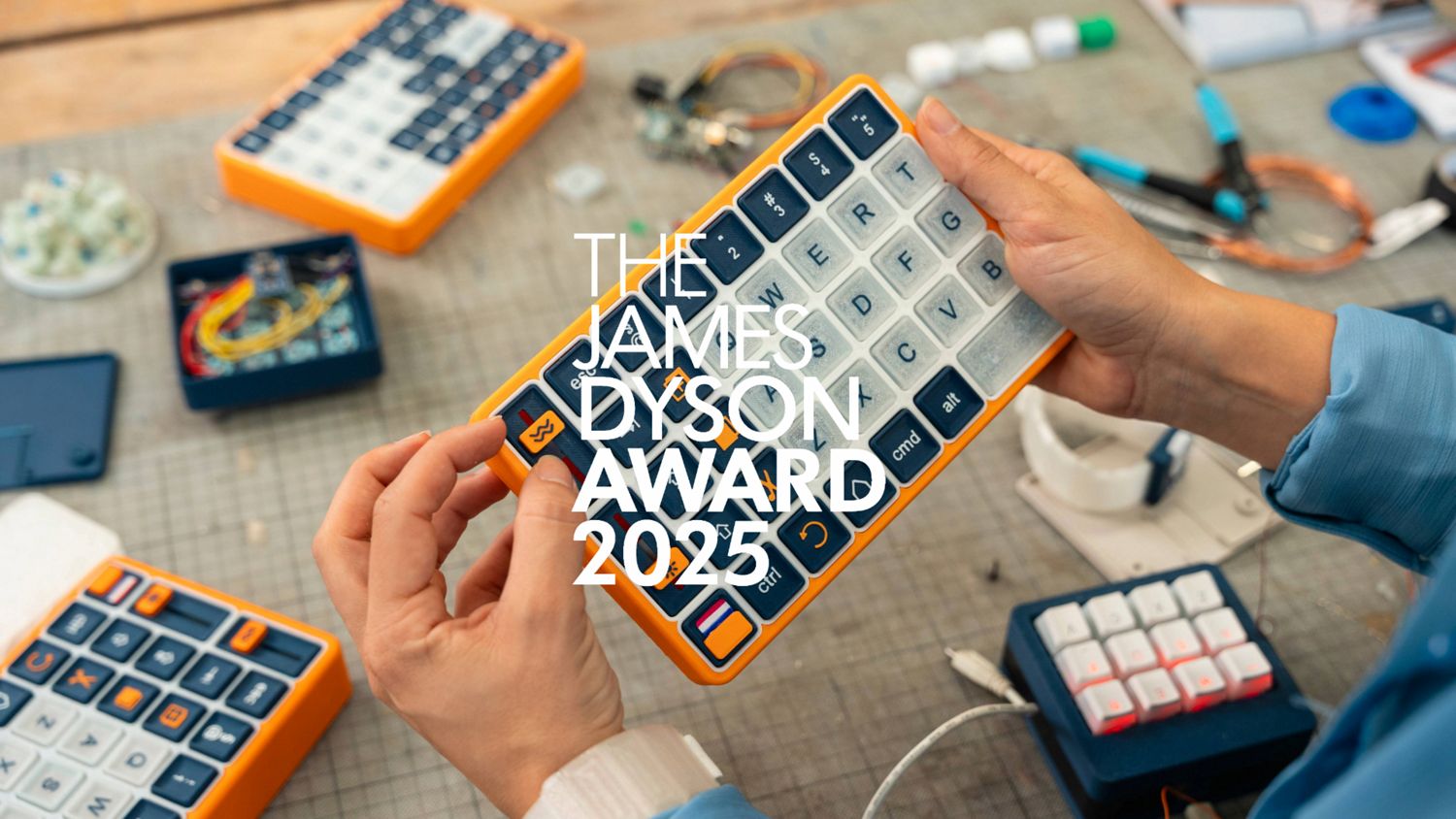
Today, the James Dyson Award reveals its two 2025 global winners, each receiving £30,000 for their inventions that advance accurate water quality monitoring and improve life with Parkinson’s.
-

SUSTAINABILITY WINNER - WATERSENSE
Invented by Filip Budny from Poland, a PhD candidate in nanotechnology at Warsaw University of Technology, WaterSense is an autonomous water quality monitoring device. It replaces manual, occasional sampling with real-time, AI-powered monitoring and early pollution alerts.
-
MEDICAL WINNER - ONCUE
Invented by Italian product designer Alessandra Galli, who graduated from Delft University of Technology in the Netherlands, OnCue is a smart keyboard for people with Parkinson’s. Unlike existing assistive keyboards, it uniquely integrates therapeutic cues into the design to reduce typing errors and help manage tremors and freezing – common symptoms of the disease.
.JPG?$responsive$)
.jpg?$responsive$)
-
“The James Dyson Award supports young inventors who think differently and tackle real-world problems head-on. Our 2025 winners, Filip and Alessandra, are a testament to that spirit – they address challenging health and environmental issues with practical, ingenious solutions. I hope that winning the Award will be a springboard for commercialising their world-beating inventions.”
Sir James Dyson, Founder of Dyson
-

Sustainability Winner - WaterSense, invented by Filip Budny
The problem: More than 40% of the world’s bodies of water are severely polluted[1]. Rivers and lakes are especially vulnerable. Unlike oceans, they are smaller, slower-moving, and more exposed to land-based pollution sources such as agricultural runoff, sewage discharges, and industrial waste[2]. Yet in many countries, monitoring remains limited and outdated, leaving critical gaps in data.
In the UK, for example, marine waters are being monitored minute-by-minute using automated buoys[3]. In contrast, rivers are typically sampled just once a month, which can miss sudden pollution events such as sewage treatment failures or agricultural runoff after heavy rain. Testing mainly focuses on nutrients like nitrogen and phosphorus, while many harmful substances such as metals, pesticides, and microplastics are not routinely measured[4].
.JPG?$responsive$)
.JPG?$responsive$)
The winning solution: Filip Budny, a PhD candidate in nanotechnology, is improving how we more accurately monitor water quality with his invention, WaterSense. Filip’s device autonomously measures the water quality of rivers and lakes in real time, to enable early detection of water pollution.
WaterSense is powered by natural water currents through a built-in hydrogenerator. Unlike conventional sensors which are made of plastic and metal components, WaterSense uses low-cost, recyclable paper sensors to measure over 20 key indicators of water quality, including pH, dissolved oxygen, nitrates, chlorides, and conductivity. It draws samples from three customisable depths, allowing for layered analysis that can detect pollutants hidden below.
The sensors are replaced automatically each day, like advancing a roll of film in a camera, ensuring consistent lab-grade accuracy without manual input. The used sensors stay housed within the device until the roll is replaced after 12 months, keeping the system fresh and reliable year-round.
.JPG?$responsive$)
.JPG?$responsive$)
The device transmits data via mobile networks to an AI-powered online platform every minute, 15 minutes, or hour, depending on monitoring needs. The online platform analyses water health and actively learns from past data and patterns to forecast pollution events up to 72 hours in advance. The results are publicly available through a website, giving communities and local authorities the insights they need to take early action and protect water ecosystems.
Currently, WaterSense prototypes are being tested in 20 locations across Poland in partnership with water companies and local governments. After winning the James Dyson Award, Filip plans to continue refining the technology and launch WaterSense in other countries.
-
”Existing water quality monitoring systems are slow, manual, and sporadic. Filip, our Sustainability winner, has invented WaterSense to measure water quality in real time and smartly predict pollution before it happens. It uses paper-based sensors which track multiple indicators of water quality at different depths, delivering more accurate readings. It’s a very worthy winner, and I look forward to seeing WaterSense floating in every river around the world.”
Sir James Dyson, Founder of Dyson
-
“The James Dyson Award confirms that environmental innovation has a global voice. It motivates me to keep pushing – to build, test, and deploy systems that make clean water measurable, predictable, and accessible to everyone. We’re now focused on expanding collaborations with environmental agencies and research partners across Europe, aiming to scale WaterSense into a continent-wide network by 2026. Our long-term vision is to monitor water quality in rivers around the world. To make this plan a reality, we’re now gathering our first investment round, to ramp up production and accelerate deployment.”
Filip Budny, inventor of WaterSense
-
“Filip's WaterSense is the first solution to systematic and real-time qualitative monitoring. It collects high-resolution data which will significantly contribute to the development of reliable forecasting models, and benefit society and ecological systems.”
Tamara Tokarczyk, Associate Professor and Hydrologist at the Institute of Meteorology and Water Management in Poland
Medical Winner - OnCue, invented by Alessandra Galli
The problem: Parkinson’s affects more than 10 million people worldwide[5]. Symptoms commonly include tremors, freezing episodes and bradykinesia – a condition that slows movement and impairs fine motor control. These challenges make typing on a keyboard difficult and often frustrating.
Currently, assistive keyboards offer features such as larger keys, high-contrast colours, and split layouts. However, they lack therapeutic cues, such as targeted vibration and visual feedback, which are tailored to address the unique motor symptoms of Parkinson’s.
.jpg?$responsive$)
.jpg?$responsive$)
The winning solution: Alessandra Galli, an integrated product design graduate, aims to help people with Parkinson’s take part confidently in today’s digital world. Her invention, OnCue, is an affordable smart keyboard paired with wristbands to make typing easier and more accurate for people with Parkinson’s. It combines haptic and visual cues to ease Parkinson’s symptoms.
OnCue sends gentle vibrations through the keyboard and wristbands each time a key is pressed, helping users keep a steady typing rhythm and feel the keys better. When a key is pressed for too long, the vibration slowly intensifies, prompting the user to release and continue with the next key. With the help of AI, OnCue predicts the next letters and lights them up on the keyboard, providing visual prompts to prevent errors and hesitation.
.jpg?$responsive$)
.jpg?$responsive$)
Inspired by gaming keyboards, OnCue features a compact, split design that reduces strain on the hands and arms, with raised key edges to minimise typing errors. Compatible with most computers and laptops, it connects wirelessly via Bluetooth and runs on a battery that lasts up to a week on a single charge.
Alessandra designed OnCue to be customisable, recognising that symptoms can vary widely for each person, and even fluctuate throughout the day. Users can fine-tune the intensity of vibrations in both the keyboard and wristbands. The keyboard’s lighting system is also adjustable to suit their needs. Alessandra is currently developing a software to personalise vibration patterns further and tailor to the user’s daily routines and symptom intensity.
Having won the James Dyson Award, Alessandra plans to continue working closely with medical professionals and people with Parkinson’s to gather feedback and further refine OnCue. She hopes to bring the device to market and expand its use to support people with other neurological conditions, including Alzheimer’s and dystonia.
-
“For those living with Parkinson’s, typing can be a frustrating experience. Alessandra has tackled this challenge by designing OnCue. When typing on the keyboard, gentle vibrations guide your rhythm while the AI predicts and lights up your next letter. The keycaps have raised edges to help your fingers find the right keys and reduce typing errors. It’s a clever and empowering solution, allowing people with Parkinson’s and other motor conditions to stay connected and communicate independently.”
Sir James Dyson, Founder of Dyson
-
“Winning the James Dyson Award is both an honour and a confirmation that committing to this project after graduation was the right decision. The James Dyson Award offers not only recognition, but also a practical opportunity to move OnCue forward. The prize provides significant support for completing the operational prototype, bringing the project one step closer to reaching people with Parkinson’s. I am confident that this achievement will also help me expand my network and open new opportunities for OnCue.”
Alessandra Galli, inventor of OnCue
-
“Having Parkinson’s Disease for more than a decade, I have experienced myself the frustration and isolation that comes from slowly losing the ability to type with fluency and ease. OnCue offers real hope for changing that – thanks to Alessandra’s outstanding design and research skills, her empathy with the target group, and her strong internal motivation to ‘do good’. Winning this award will enable her to take the project further, which is very good news for the entire Parkinson’s community.”
Gert Pasman, Senior Lecturer, Faculty of Industrial Design Engineering at Delft University of Technology
FAQs
1. What is the James Dyson Award?
The James Dyson Award is an international design competition that supports and celebrates students inventors solving real-world problems. It is run annually by the James Dyson Foundation.
2. What makes the 2025 James Dyson Award winners unique?
WaterSense enables autonomous, real-time monitoring of water quality. Its AI-powered platform analyses water health and forecasts pollution events up to 72 hours in advance. OnCue empowers people with Parkinson's to stay connected in a digital world, by integrating therapeutic cues directly into the keyboard and wristbands.
3. How were the winning inventions selected?
A panel of Dyson engineers shortlisted 20 global finalists from the national winners and runners-up of the Award, based on functionality, design process, originality, and commercial viability. Sir James Dyson then selected the global winners from this shortlist.
Press contacts
-
Dyson Press Office
Email: Press.Office@dyson.com
-
James Dyson Award
- Website: https://www.jamesdysonaward.org/
- Instagram: @jamesdysonaward
- X: @jamesdysonaward
- TikTok: @jamesdysonaward
- LinkedIn: James Dyson Award
- YouTube: youtube.com/jamesdysonfoundation